
Artificial intelligence is no longer a futuristic concept—it is shaping how businesses operate, how people work, and how technology evolves. At the center of this transformation is Microsoft, one of the world’s most influential technology companies. Behind Microsoft’s rapid progress in artificial intelligence is strong leadership, often discussed through the lens of the Microsoft AI CEO.
Understanding who leads Microsoft’s AI strategy, how decisions are made, and what vision guides the company provides valuable insight into where AI is heading globally. This article explores the role of the Microsoft AI CEO, the leadership structure behind Microsoft’s AI initiatives, and what it means for the future of technology.
Microsoft AI CEO (Quick Overview)
The term Microsoft AI CEO commonly refers to the executive leadership responsible for Microsoft’s artificial intelligence strategy, vision, and execution. While Microsoft does not have a single standalone “AI-only CEO,” AI leadership is driven at the highest level by Microsoft’s top executives, with AI integrated into the company’s core mission and long-term strategy.
Understanding Microsoft’s AI Leadership Structure
To understand the idea of a Microsoft AI CEO, it’s important to recognize how Microsoft organizes leadership.
Microsoft operates with:
- A Chief Executive Officer overseeing the entire company
- Senior executives leading divisions such as cloud, AI, and enterprise solutions
- Dedicated AI leadership teams responsible for research, product integration, and ethics
Rather than isolating AI under a single executive title, Microsoft embeds AI leadership across its organization.
Satya Nadella’s Role in Microsoft AI Strategy
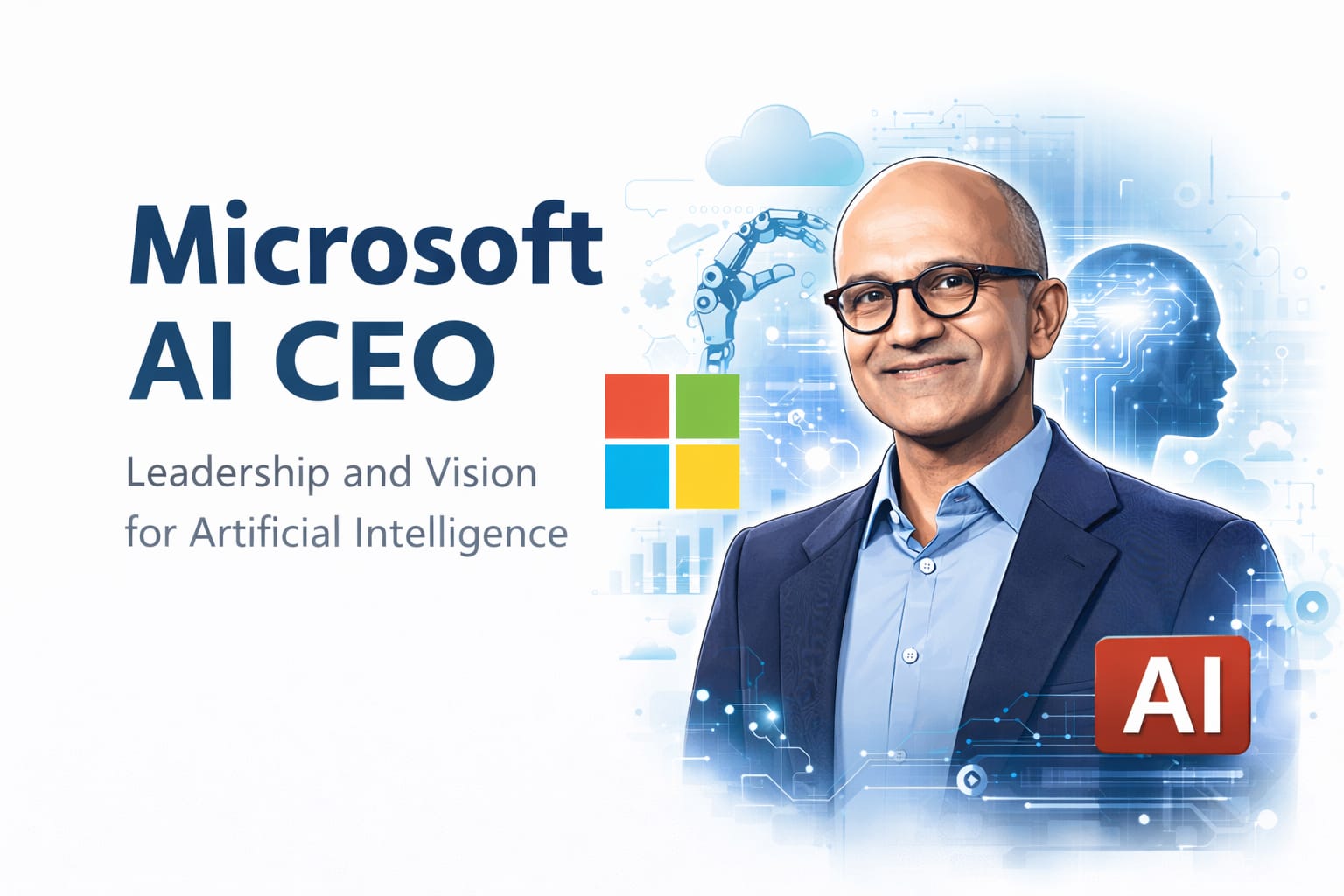
When people search for Microsoft AI CEO, they are often referring to Satya Nadella, Microsoft’s CEO, who has been instrumental in shaping the company’s AI-first direction.
Since becoming CEO, Nadella has:
- Positioned AI as a core pillar of Microsoft’s mission
- Integrated AI across products like Azure, Microsoft 365, and Windows
- Focused on responsible and ethical AI development
Under his leadership, AI is not a side project—it is central to Microsoft’s identity.

Why Microsoft Does Not Have a Separate AI CEO
Unlike some companies that create standalone AI subsidiaries, Microsoft takes a different approach.
Reasons include:
- AI is embedded in nearly every Microsoft product
- Centralized AI leadership could slow innovation
- Cross-team collaboration accelerates AI deployment
This structure allows Microsoft to scale AI rapidly while maintaining consistency and control.
The Vision Behind Microsoft’s AI Strategy
Microsoft’s AI vision focuses on empowerment rather than replacement.
Key principles include:
- AI as a tool to enhance human productivity
- Accessibility of AI for businesses of all sizes
- Ethical development and responsible deployment
The Microsoft AI CEO philosophy emphasizes long-term trust over short-term gains.
Microsoft AI Research and Innovation
Microsoft is home to one of the world’s largest AI research organizations.
Microsoft Research:
- Advances machine learning, natural language processing, and computer vision
- Collaborates with universities and global institutions
- Publishes research that shapes the broader AI ecosystem
This research-driven culture supports the leadership vision behind Microsoft’s AI strategy.
AI Integration Across Microsoft Products
One defining characteristic of Microsoft’s AI leadership is integration.
Examples include:
- AI-powered productivity tools in Microsoft 365
- Intelligent cloud services through Azure AI
- Developer tools that embed AI into applications
- Security systems enhanced by AI threat detection
Rather than marketing AI separately, Microsoft weaves it into everyday tools.
Ethical AI and Governance
A major responsibility associated with the Microsoft AI CEO role is ensuring ethical AI use.
Microsoft has established:
- AI ethics committees
- Responsible AI principles
- Transparency and accountability frameworks
These efforts aim to address concerns around bias, privacy, and misuse—issues critical to public trust.
Microsoft AI CEO and the Partnership with OpenAI
Microsoft’s partnership with OpenAI has become a defining element of its AI strategy.
This collaboration allows:
- Integration of advanced AI models into Microsoft products
- Shared research and infrastructure
- Accelerated innovation in generative AI
Leadership oversight ensures this partnership aligns with Microsoft’s broader values and business goals.
How Microsoft AI Leadership Impacts Businesses
Businesses benefit directly from Microsoft’s AI-driven leadership approach.
Impacts include:
- Easier access to AI tools
- Scalable AI solutions through cloud services
- Enhanced data analysis and automation
For many organizations, Microsoft serves as the gateway to practical AI adoption.
The Competitive Landscape of AI Leadership
Microsoft competes with other major players in AI, including tech giants and emerging startups.
What sets Microsoft apart:
- Enterprise focus
- Strong cloud infrastructure
- Emphasis on responsible AI
- Deep integration into business workflows
The Microsoft AI CEO vision prioritizes sustainability over hype.
Challenges Facing Microsoft’s AI Leadership
Despite success, challenges remain.
These include:
- Managing rapid AI adoption responsibly
- Addressing regulatory scrutiny
- Balancing innovation with user privacy
- Keeping pace with fast-moving competitors
Strong leadership is essential to navigate these complexities.
Microsoft AI CEO and the Future of Work
AI is reshaping how people work, and Microsoft’s leadership plays a central role in that shift.
Future-focused initiatives include:
- AI-powered assistants
- Automation of repetitive tasks
- Enhanced collaboration tools
- Personalized digital experiences
The goal is to help people focus on creativity and decision-making rather than routine work.
The Global Impact of Microsoft’s AI Direction
Microsoft’s AI decisions influence:
- Global businesses
- Governments and policy discussions
- Education and workforce development
Leadership at the top ensures AI growth aligns with global responsibility.
Why the Microsoft AI CEO Concept Matters
Even without an official title, the idea of a Microsoft AI CEO matters because it represents accountability.
It reflects:
- Strategic direction
- Ethical oversight
- Long-term planning
AI leadership at Microsoft is not about one individual—it’s about coordinated vision at the highest level.
How Microsoft AI Leadership Shapes Innovation Culture
Microsoft’s AI culture encourages:
- Experimentation
- Collaboration
- Continuous learning
Employees are empowered to innovate while adhering to ethical standards.
What the Future Holds for Microsoft AI Leadership
Looking ahead, Microsoft’s AI leadership is expected to:
- Expand generative AI capabilities
- Increase AI accessibility worldwide
- Strengthen regulatory compliance
- Deepen AI integration into daily life
The Microsoft AI CEO vision will continue evolving as technology advances.
Final Thoughts: Understanding the Microsoft AI CEO
The concept of a Microsoft AI CEO represents more than a job title—it reflects how Microsoft approaches artificial intelligence at the highest level. Rather than isolating AI leadership, Microsoft embeds it into its core executive strategy, ensuring innovation, responsibility, and scalability move together.
Under strong leadership, Microsoft has positioned itself as a trusted AI partner for individuals, businesses, and governments alike. As artificial intelligence continues to reshape the world, Microsoft’s leadership model offers a blueprint for balancing innovation with accountability.
In the end, the future of AI at Microsoft is not defined by one person, but by a unified vision that places human empowerment at the center of technological progress.